I have spent three decades helping people make sense of complicated illness. I have also lived through the uncertainty, pain, exhaustion, and profound reorientation that autoimmune disease can bring to a life.
My clinical work brings together Traditional Chinese Medicine, acupuncture, functional and nutritional assessment, movement, breath, somatic awareness, and the practical realities of living with chronic illness.
I am interested in the whole person — not because every symptom has one simple root cause, but because no system in the body lives, adapts, or heals in isolation.
People often arrive after years of collecting diagnoses, laboratory reports, dietary restrictions, medications, supplements, treatment plans, and occasionally contradictory explanations. Some have a clearly established autoimmune condition. Others know that something has changed, even though their symptoms have not yet formed a pattern that conventional testing can easily name.
My first task is not to add another theory to the pile. It is to listen carefully, understand the history, identify the present priorities, and help create a sequence of care that respects both the complexity of the condition and the capacity of the person living with it.
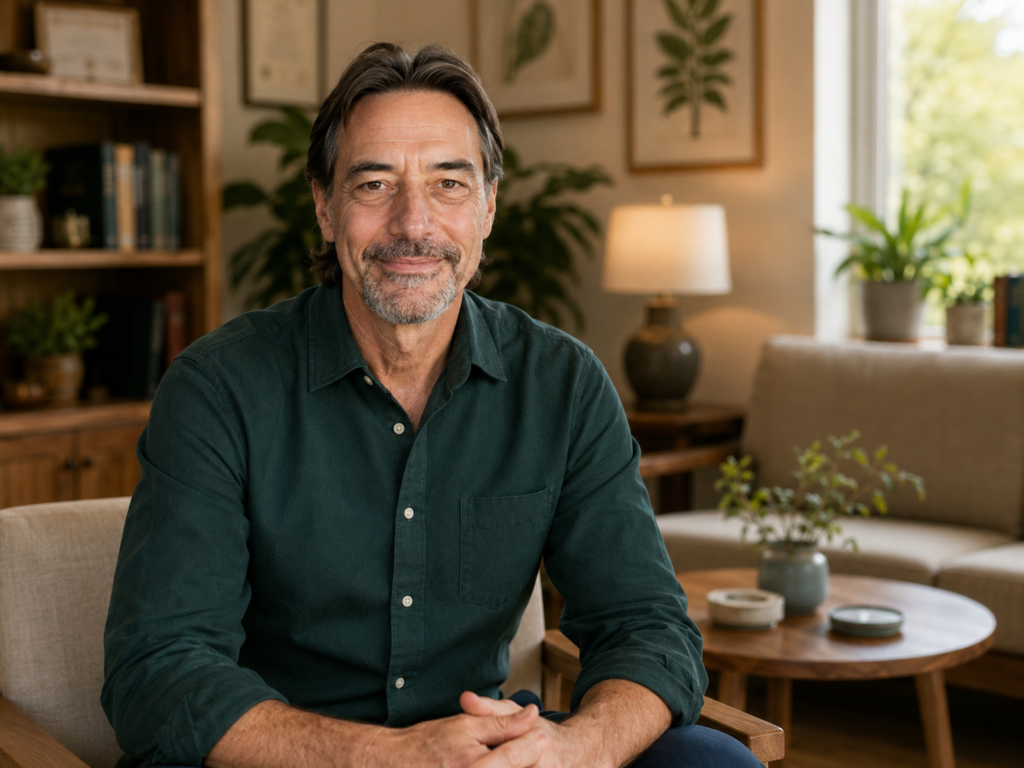
Many years ago, I went from being a 165-pound athlete to a 112-pound patient in intensive care with a severe combination of Crohn’s disease and colitis. At one point, I was told that I might have only days to live.
Conventional medicine saved my life. That truth has remained important throughout my career. Emergency medicine, surgery, medications, diagnostic testing, and specialist care can be indispensable. There are times when the body needs decisive intervention, and no amount of dietary discipline, meditation, acupuncture, or positive thinking should be used to delay it.
Surviving the immediate crisis, however, was not the same as knowing how to live afterward. I had survived, but the body I returned to was not the body I had known before. I had to learn how to nourish it, move within it, rest without guilt, and recognize the difference between useful effort and another form of depletion.
My longer recovery drew upon conventional care, Traditional Chinese Medicine, acupuncture, nutrition, supplementation, movement, meditation, breathwork, and genuine periods of rest. No single intervention restored my health. What helped was the gradual creation of better conditions — followed by observation, patience, adaptation, and a willingness to change direction when something was not working.
That experience did not give me a universal answer to autoimmune illness. It gave me a deeper respect for complexity. It also gave me a lasting respect for the courage required to live in a body that other people cannot fully see.
I began practising in 1996. Over the decades, my work has continued to evolve as my patients, my own health, and the available science have asked better questions of me.
Traditional Chinese Medicine gave me my original clinical language. It taught me to recognize patterns rather than chase isolated symptoms, to consider constitution alongside present illness, and to understand health through relationships among nourishment, circulation, digestion, rest, adaptation, and the rhythms of a person’s life.
Functional and nutritional assessment added another level of resolution. It offered ways to investigate physiology, laboratory findings, medication history, digestion, metabolism, nutrient status, inflammation, and other potentially modifiable influences on health.
Acupuncture and physical medicine gave me direct ways to work with pain, regulation, mobility, circulation, and embodied function.
My decades of qigong, martial arts, meditation, breathwork, and somatic practice taught me something equally important: people do not experience illness as an abstract biochemical event. They experience it through sensation, movement, emotion, attention, identity, relationship, and the changing possibilities of everyday life.
These disciplines do not replace one another. They provide different levels of resolution through which to understand the same living person.
Autoimmune illness is complicated because the immune system does not act alone. Immune activity is continually influenced by metabolism, nutrition, digestion, sleep, infection history, medication, hormones, movement, pain, stress physiology, environmental exposure, social conditions, and the health of the tissues the immune system is attempting to protect.
None of these factors explains every case. A stressful life event does not automatically cause autoimmune disease. A dietary change does not universally reverse it. An abnormal laboratory result is not always the centre of the problem. A diagnosis may be accurate without explaining the full experience of the patient.
The clinical task is therefore not to force every person into one theory. It is to look for meaningful relationships:
When did the symptoms begin?
What changed beforehand?
Which systems appear to be struggling together?
What has already been investigated?
Which diagnoses are established, and which remain uncertain?
What has helped?
What has made things worse?
What does the person have enough strength, time, money, support, and attention to undertake now?
I am interested in underlying contributors, but I am cautious with the phrase root cause. Complex illness often develops through several overlapping influences rather than one hidden culprit waiting to be discovered. Even when a significant contributor is identified, the body may still need time, nourishment, rehabilitation, symptom support, and appropriate medical treatment.
The goal is not to generate the longest possible list of problems. It is to determine which findings matter, which interventions are proportionate, and what order of care gives the person the best opportunity to respond.
The Epigenetic Autoimmune Protocol — the Epi-AIP — grew out of three decades of clinical observation, personal illness, teaching, research, and repeated conversations with people trying to understand what had happened to their bodies.
Many patients did not need another list. They needed a way to understand direction. They needed to know whether the system first required quiet, nourishment, rehabilitation, or a return to fuller participation. They needed to understand why an intervention that was helpful during crisis might later become unnecessarily restrictive. They needed a way to see progress before every symptom had disappeared. They also needed language for the deeper human problem of remaining highly capable while spending more adaptability than the body could restore.
Over time, these observations became three connected maps.
The Five Stages describe the apparent direction and momentum of the autoimmune process. They help us consider whether the system is becoming more reactive, more depleted, more actively autoimmune, increasingly complex, or gradually moving toward renewal.
The Four Phases organize the work:
They follow the natural logic of healing: settle and protect, repair and rebuild, rehabilitate and test, then reintegrate.
The Six Pillars keep the process whole:
Each Pillar changes across the Four Phases.
One of the central ideas within the Epi-AIP is that health is not a permanently balanced state. Health is the capacity to respond, reorganize, recover, and return.
A person may continue functioning while that adaptability is steadily narrowing. They may still work, exercise, care for others, and meet substantial responsibilities. But the cost rises, and recovery becomes less dependable.
This is why function is not the same as capacity. The more useful question is not only, Can you do it? It is, What does it cost, and how long does it take you to recover?
The Epi-AIP helps make this changing relationship visible.
Chronic illness often reveals a difficult division. There is the self who knows — and the self who continues.
A person may know that the pace is unsustainable, that recovery is no longer reliable, or that a form of work, training, responsibility, or relationship has become incompatible with the body carrying it. They may also have excellent reasons to continue.
The Epi-AIP refers to the distance between inner knowledge and outer life as the authenticity wound. This does not mean emotional conflict caused the illness. It means recovery becomes more difficult when care itself remains another form of self-abandonment.
Healing includes learning to recognize truth earlier. It means developing enough self-loyalty that the body does not need to collapse before its information becomes legitimate.
The goal is not to become less ambitious, less generous, or less capable. It is to find forms of ambition, service, discipline, and responsibility that do not continually require the person to disappear.
I listen for the whole history. Complex illness often becomes more intelligible when its chronology is understood.
I look for priorities rather than perfection. A useful plan should distinguish among what is urgent, what is foundational, what is experimental, and what can safely wait.
I explain my reasoning. Patients deserve to understand what we are trying to influence, why a recommendation appears relevant, and how we will judge whether it is helping.
I respect capacity. A technically impressive plan that an exhausted person cannot carry out is not an excellent plan.
I remain willing to revise the map. Clinical work begins with a working understanding, not an infallible conclusion. Symptoms change. New information becomes available. Life intervenes. A good plan provides direction while remaining flexible enough to learn.
I work alongside appropriate medical care. Integrative care should not require you to choose sides.
I have spent much of my life studying how people heal, adapt, move, and make meaning. That work has taken place in clinics, classrooms, meditation halls, martial arts schools, treatment rooms, and within my own body.
I continue to teach because understanding changes the quality of participation. A person does not need to master every detail of their illness. But they deserve enough clarity to recognize what matters, ask better questions, and participate intelligently in their care without becoming consumed by it.
I continue to study because no living system is fully explained by one tradition. And I continue to write because sometimes a thoughtful conversation can change the direction of a person’s journey before another treatment is added.
The purpose of this work is not to promise perfect control. Autoimmune illness can remain dynamic. The body can still surprise us. But the relationship with the process can become more informed, more skillful, and more honest.
You can learn to recognize direction
You can understand what the present Phase asks
You can rebuild adaptability without turning recovery into another form of self-abandonment
You can become less dependent upon crisis to tell you the truth
That is the deeper intention behind All Things Autoimmunity and the Epi-AIP.
Book an initial consultation and begin building a plan that fits you, your life, and your health.
The information on this website is provided for general educational purposes. It is not a substitute for individualized medical advice, diagnosis, emergency assessment, or treatment from your physician or another qualified healthcare professional.